
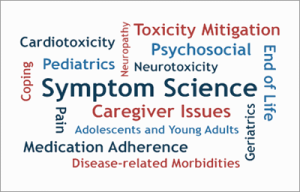
The Supportive Care and Symptom Management program supports studies on the prevention or treatment of acute and chronic symptoms and morbidities related to cancer and its treatment. This includes the impact on the quality of life of patients and their informal caregivers. The program also supports studies of patients and their caregivers at the end of life.
On This Page
- All Heading 2s will automatically be pulled in to this list.
- Do not edit the content on this template.
About Supportive Care and Symptom Management
The program supports research in three areas: prevention or treatment of acute or chronic symptoms and morbidities related to cancer, its treatment and caregiving (symptom management research); effects on quality of life from cancer, its treatment and caregiving (quality of life research); and end-of-life psychosocial issues, caregiving and treatment strategies (end-of-life research).
Through the NCI Community Oncology Research Program (NCORP), clinical trials are underway to evaluate therapies to prevent or ameliorate a broad range of symptoms and/or toxicities associated with cancer its treatment and caregiving. Other studies funded separately are investigating a range of treatment effects on health-related quality of life and a variety of influences on the end-of-life cancer experience.
Topic Areas include: Anorexia, Cachexia, Cardiotoxicity, Caregiver Issues, Cognitive Dysfunction, Distress/Anxiety/Depression, End of Life, Fatigue, Geriatrics, Hot Flashes, Lymphedema, Medication Adherence, Mucositis, Multiple Symptoms, Musculoskeletal Symptoms, Nausea, Neuropathy, Nutrition, Oral Complications, Other Supportive Care Issues, Pain, Palliative Care, Pediatrics/Adolescents/Young Adult, Physical Functioning, Quality of Life, Skin Toxicities, Sleep Disorders, and Urinary Complications.
Selected Topics
- HEAL Initiative
- Patient Resources on Side Effects of Cancer Treatment
- Patient Resources on Coping with Cancer
Resources
-
 Building Bridges in Cancer Symptom Science Webinar Series
This series is aimed at bringing together interdisciplinary researchers in cancer symptom science to share their expertise and further discussions in the field.
-
 DCP Early Career Scientist Spotlight Research Seminar Series
This seminar series highlights nominated early career scientists who are advancing research within the areas supported by DCP.
Funding Opportunities
No matching Funding Opportunities were found.
Grantee Details
Clinical Trials
| Title | Intervention | Sponsor | Status |
|---|---|---|---|
| Treatment Effects on Development of Chemotherapy-Induced Peripheral Neuropathy in Patients With Cancer | Chemotherapy, Functional Assessment, Questionnaire Administration | SWOG Cancer Research Network | Active, not recruiting |
| Bupropion to Reduce Cancer Related Fatigue in Cancer Survivors | Biospecimen Collection, Bupropion Hydrochloride Controlled-release, Placebo Administration, Quality-of-Life Assessment, Questionnaire Administration | University of Rochester NCORP Research Base | Active, not recruiting |
| Myopenia and Mechanisms of Chemotherapy Toxicity in Older Adults With Colorectal Cancer | Wake Forest University Health Sciences | Recruiting | |
| Taxane and Taxane-Induced Peripheral Neuropathy in African American Patients With Stage I-III Breast Cancer | Docetaxel, Paclitaxel, Quality-of-Life Assessment, Questionnaire Administration | ECOG-ACRIN Cancer Research Group | Active, not recruiting |
| Learning Collaborative Versus Technical Assistance in Delivering a Palliative Care Program to Patients With Advanced Cancer and Their Caregivers | Behavioral, Psychological or Informational Intervention, Educational Intervention, Medical Examination Assessment, Quality-of-Life Assessment, Survey Administration, Telephone-Based Intervention | University of Rochester NCORP Research Base | Active, not recruiting |
| A Text-based Intervention in Improving Adherence to Hormone Therapy in Patients With Stage I-III Hormone Receptor Positive Breast Cancer | Best Practice, Focus Group, Questionnaire Administration, Text Message | Thomas Jefferson University | Active, not recruiting |
| Gut Microbe Composition, Exercise, and Breast Breast Cancer Survivors | Aerobic Exercise Training, Attention Control | University of Alabama at Birmingham | Active, not recruiting |
| Mobile Health and Social Media Physical Activity Intervention Among Adolescent and Young Adult Childhood Cancer Survivors, the StepByStep Study | Educational Intervention, FitBit, Goal Setting, Health Promotion and Education, Media Intervention, Telephone-Based Intervention | Children's Oncology Group | Active, not recruiting |
| Duloxetine to Prevent Oxaliplatin-Induced Peripheral Neuropathy in Patients With Stage II-III Colorectal Cancer | Duloxetine, Duloxetine Hydrochloride, Oxaliplatin, Placebo, Quality-of-Life Assessment, Questionnaire Administration | Alliance for Clinical Trials in Oncology | Active, not recruiting |
| Additional Support Program Via Text Messaging and Telephone-Based Counseling for Breast Cancer Patients Receiving Hormonal Therapy | Best Practice, Educational Intervention, Motivational Interviewing, Quality-of-Life Assessment, Questionnaire Administration, Text Message-based Navigation Intervention | Alliance for Clinical Trials in Oncology | Active, not recruiting |
News and Events
Personalised Risk in Lung Screening
Date Posted: April 24, 2025
Cancer Cachexia: From Preclinical Models to Bedside Interventions
Date Posted: March 25, 2025
Survivorship in Patients with Multiple Myeloma Treated with Chimeric Antigen Receptor T-Cell Therapy
Date Posted: March 25, 2025