
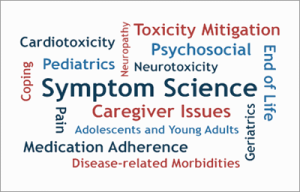
The Supportive Care and Symptom Management program supports studies on the prevention or treatment of acute and chronic symptoms and morbidities related to cancer and its treatment. This includes the impact on the quality of life of patients and their informal caregivers. The program also supports studies of patients and their caregivers at the end of life.
On This Page
- All Heading 2s will automatically be pulled in to this list.
- Do not edit the content on this template.
About Supportive Care and Symptom Management
The program supports research in three areas: prevention or treatment of acute or chronic symptoms and morbidities related to cancer, its treatment and caregiving (symptom management research); effects on quality of life from cancer, its treatment and caregiving (quality of life research); and end-of-life psychosocial issues, caregiving and treatment strategies (end-of-life research).
Through the NCI Community Oncology Research Program (NCORP), clinical trials are underway to evaluate therapies to prevent or ameliorate a broad range of symptoms and/or toxicities associated with cancer its treatment and caregiving. Other studies funded separately are investigating a range of treatment effects on health-related quality of life and a variety of influences on the end-of-life cancer experience.
Topic Areas include: Anorexia, Cachexia, Cardiotoxicity, Caregiver Issues, Cognitive Dysfunction, Distress/Anxiety/Depression, End of Life, Fatigue, Geriatrics, Hot Flashes, Lymphedema, Medication Adherence, Mucositis, Multiple Symptoms, Musculoskeletal Symptoms, Nausea, Neuropathy, Nutrition, Oral Complications, Other Supportive Care Issues, Pain, Palliative Care, Pediatrics/Adolescents/Young Adult, Physical Functioning, Quality of Life, Skin Toxicities, Sleep Disorders, and Urinary Complications.
Selected Topics
- HEAL Initiative
- Patient Resources on Side Effects of Cancer Treatment
- Patient Resources on Coping with Cancer
Resources
-
 Building Bridges in Cancer Symptom Science Webinar Series
This series is aimed at bringing together interdisciplinary researchers in cancer symptom science to share their expertise and further discussions in the field.
-
 DCP Early Career Scientist Spotlight Research Seminar Series
This seminar series highlights nominated early career scientists who are advancing research within the areas supported by DCP.
Funding Opportunities
No matching Funding Opportunities were found.
Grantee Details
Clinical Trials
| Title | Intervention Sort descending | Sponsor | Status |
|---|---|---|---|
| Use of a Pre-Surgical Toolkit in Improving Surgical Care and Outcomes in Older Participants With Cancer | Best Practice, Informational Intervention, Informational Intervention with Coaching, Questionnaire Administration | Alliance for Clinical Trials in Oncology | Active, not recruiting |
| Testing the Application of Mepitel Film During Radiation Therapy to Reduce Radiation Related Redness and Peeling in Breast Cancer Patients Following Mastectomy | Best Practice, Quality-of-Life Assessment, Questionnaire Administration, Wound Dressing Material | Alliance for Clinical Trials in Oncology | Active, not recruiting |
| Bupropion to Reduce Cancer Related Fatigue in Cancer Survivors | Biospecimen Collection, Bupropion Hydrochloride Controlled-release, Placebo Administration, Quality-of-Life Assessment, Questionnaire Administration | University of Rochester NCORP Research Base | Active, not recruiting |
| Studying the Effect of Levocarnitine in Protecting the Liver From Chemotherapy for Leukemia or Lymphoma | Biospecimen Collection, Calaspargase Pegol, Levocarnitine, Pegaspargase, Quality-of-Life Assessment | Children's Oncology Group | Recruiting |
| A Study to Learn More About the Health of Persons With Down Syndrome After Treatment for Acute Leukemia | Biospecimen Collection, Clinical Evaluation, Neurocognitive Assessment, Questionnaire Administration, Survey Administration | Children's Oncology Group | Recruiting |
| A Study to See if Memantine Protects the Brain During Radiation Therapy Treatment for a Brain Tumor | Biospecimen Collection, Cognitive Assessment, Magnetic Resonance Imaging, Memantine Hydrochloride, Placebo Administration, Questionnaire Administration | Children's Oncology Group | Active, not recruiting |
| LOTUS-CC: An Observational Research Study to Uncover Subtypes of Cancer Cachexia | Biospecimen Collection, Computed Tomography, Electronic Health Record Review, Medical Device Usage and Evaluation, Physical Performance Testing, Positron Emission Tomography, Survey Administration | University of Rochester | Recruiting |
| Comparing Cooling and/or Compression Approaches of Limbs for Prevention of Chemotherapy-Induced Peripheral Neuropathy | Biospecimen Collection, Cryocompression Therapy, Pneumatic Compression Therapy, Quality-of-Life Assessment, Questionnaire Administration | SWOG Cancer Research Network | Recruiting |
| Vitamin D for Prostate Endocrine Therapy | Biospecimen Collection, D Vitamin, Dual X-ray Absorptiometry, Placebo Administration, Quality-of-Life Assessment, Questionnaire Administration | University of Rochester | Recruiting |
| Impact of Sentinel Lymph Node Mapping on Patient Reported Lower Extremity Limb Dysfunction in Stage I Endometrial Cancer | Biospecimen Collection, Diagnostic Imaging Testing, Excisional Biopsy, Indocyanine Green Solution, Minimally Invasive Surgery, Pelvic Lymphadenectomy, Questionnaire Administration, Sentinel Lymph Node Mapping | NRG Oncology | Recruiting |
News and Events
Personalised Risk in Lung Screening
Date Posted: April 24, 2025
Cancer Cachexia: From Preclinical Models to Bedside Interventions
Date Posted: March 25, 2025
Survivorship in Patients with Multiple Myeloma Treated with Chimeric Antigen Receptor T-Cell Therapy
Date Posted: March 25, 2025