
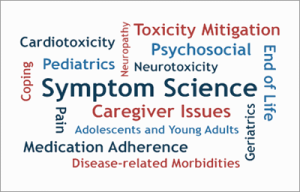
The Supportive Care and Symptom Management program supports studies on the prevention or treatment of acute and chronic symptoms and morbidities related to cancer and its treatment. This includes the impact on the quality of life of patients and their informal caregivers. The program also supports studies of patients and their caregivers at the end of life.
On This Page
- All Heading 2s will automatically be pulled in to this list.
- Do not edit the content on this template.
About Supportive Care and Symptom Management
The program supports research in three areas: prevention or treatment of acute or chronic symptoms and morbidities related to cancer, its treatment and caregiving (symptom management research); effects on quality of life from cancer, its treatment and caregiving (quality of life research); and end-of-life psychosocial issues, caregiving and treatment strategies (end-of-life research).
Through the NCI Community Oncology Research Program (NCORP), clinical trials are underway to evaluate therapies to prevent or ameliorate a broad range of symptoms and/or toxicities associated with cancer its treatment and caregiving. Other studies funded separately are investigating a range of treatment effects on health-related quality of life and a variety of influences on the end-of-life cancer experience.
Topic Areas include: Anorexia, Cachexia, Cardiotoxicity, Caregiver Issues, Cognitive Dysfunction, Distress/Anxiety/Depression, End of Life, Fatigue, Geriatrics, Hot Flashes, Lymphedema, Medication Adherence, Mucositis, Multiple Symptoms, Musculoskeletal Symptoms, Nausea, Neuropathy, Nutrition, Oral Complications, Other Supportive Care Issues, Pain, Palliative Care, Pediatrics/Adolescents/Young Adult, Physical Functioning, Quality of Life, Skin Toxicities, Sleep Disorders, and Urinary Complications.
Selected Topics
- HEAL Initiative
- Patient Resources on Side Effects of Cancer Treatment
- Patient Resources on Coping with Cancer
Resources
-
 Building Bridges in Cancer Symptom Science Webinar Series
This series is aimed at bringing together interdisciplinary researchers in cancer symptom science to share their expertise and further discussions in the field.
-
 DCP Early Career Scientist Spotlight Research Seminar Series
This seminar series highlights nominated early career scientists who are advancing research within the areas supported by DCP.
Funding Opportunities
No matching Funding Opportunities were found.
Grantee Details
Clinical Trials
| Title | Intervention | Sponsor | Status |
|---|---|---|---|
| Geriatric Evaluation and Management With Survivorship Health Education for Older Survivors of Cancer, GEM-S Trial | Best Practice, Comprehensive Geriatric Assessment, Educational Intervention, Exercise Intervention, Questionnaire Administration, Tailored Intervention | University of Rochester | Recruiting |
| Gut Microbe Composition, Exercise, and Breast Breast Cancer Survivors | Aerobic Exercise Training, Attention Control | University of Alabama at Birmingham | Active, not recruiting |
| Haloperidol and Lorazepam in Controlling Symptoms of Persistent Agitated Delirium in Patients With Advanced Cancer Undergoing Palliative Care | Haloperidol, Lorazepam, Placebo, Quality-of-Life Assessment, Questionnaire Administration | M.D. Anderson Cancer Center | Active, not recruiting |
| Immune Checkpoint Inhibitor Toxicity Risk Prediction in Solid Tumors | Biospecimen Collection, Questionnaire Administration | SWOG Cancer Research Network | Recruiting |
| Impact of Sentinel Lymph Node Mapping on Patient Reported Lower Extremity Limb Dysfunction in Stage I Endometrial Cancer | Biospecimen Collection, Diagnostic Imaging Testing, Excisional Biopsy, Indocyanine Green Solution, Minimally Invasive Surgery, Pelvic Lymphadenectomy, Questionnaire Administration, Sentinel Lymph Node Mapping | NRG Oncology | Recruiting |
| Improving Adolescent and Young Adult Self-Reported Data in ECOG-ACRIN Trials | Questionnaires | Eastern Cooperative Oncology Group | Recruiting |
| Increasing Patients' Engagement in Breast Cancer Surgery Decision-Making | Usual Care, Web-based decision aid | Alliance for Clinical Trials in Oncology | Active, not recruiting |
| IVIG for Infection Prevention After CAR-T-Cell Therapy | Anti-CD19 CAR T Cells Preparation, Biospecimen Collection, Electronic Health Record Review, Immune Globulin Infusion (Human), 10% Solution, Saline, Survey Administration | Fred Hutchinson Cancer Center | Recruiting |
| Lactobacillus Plantarum in Preventing Acute Graft Versus Host Disease in Children Undergoing Donor Stem Cell Transplant | Allogeneic Hematopoietic Stem Cell Transplantation, Lactobacillus plantarum strain 299, Lactobacillus plantarum strain 299v, Placebo Administration | Children's Oncology Group | Active, not recruiting |
| Lanreotide Versus Placebo Before Surgery to Prevent a Surgical Complication Called a Pancreatic Fistula | Biospecimen Collection, Distal Pancreatectomy, Lanreotide, Questionnaire Administration, Saline | SWOG Cancer Research Network | Recruiting |
News and Events
Linking the Macroenvironment and Microenvironment to Study Breast Cancer Etiology and Progression
Date Posted: March 17, 2025
Engineering Orthogonal Breath Biomarkers for Multiplexed Cancer Diagnostics
Date Posted: February 25, 2025
Prevention and Screening Drive Drop in Cancer Deaths
Date Posted: January 14, 2025
Meet the 2025 Cohort of the DCP Early Career Scientists
Date Posted: November 26, 2024
Day 2: NCI Cancer Integrative Medicine Grantee Conference (Virtual)
Date Posted: November 21, 2024