
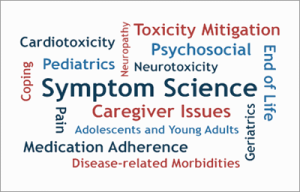
The Supportive Care and Symptom Management program supports studies on the prevention or treatment of acute and chronic symptoms and morbidities related to cancer and its treatment. This includes the impact on the quality of life of patients and their informal caregivers. The program also supports studies of patients and their caregivers at the end of life.
On This Page
- All Heading 2s will automatically be pulled in to this list.
- Do not edit the content on this template.
About Supportive Care and Symptom Management
The program supports research in three areas: prevention or treatment of acute or chronic symptoms and morbidities related to cancer, its treatment and caregiving (symptom management research); effects on quality of life from cancer, its treatment and caregiving (quality of life research); and end-of-life psychosocial issues, caregiving and treatment strategies (end-of-life research).
Through the NCI Community Oncology Research Program (NCORP), clinical trials are underway to evaluate therapies to prevent or ameliorate a broad range of symptoms and/or toxicities associated with cancer its treatment and caregiving. Other studies funded separately are investigating a range of treatment effects on health-related quality of life and a variety of influences on the end-of-life cancer experience.
Topic Areas include: Anorexia, Cachexia, Cardiotoxicity, Caregiver Issues, Cognitive Dysfunction, Distress/Anxiety/Depression, End of Life, Fatigue, Geriatrics, Hot Flashes, Lymphedema, Medication Adherence, Mucositis, Multiple Symptoms, Musculoskeletal Symptoms, Nausea, Neuropathy, Nutrition, Oral Complications, Other Supportive Care Issues, Pain, Palliative Care, Pediatrics/Adolescents/Young Adult, Physical Functioning, Quality of Life, Skin Toxicities, Sleep Disorders, and Urinary Complications.
Selected Topics
- HEAL Initiative
- Patient Resources on Side Effects of Cancer Treatment
- Patient Resources on Coping with Cancer
Resources
-
 Building Bridges in Cancer Symptom Science Webinar Series
This series is aimed at bringing together interdisciplinary researchers in cancer symptom science to share their expertise and further discussions in the field.
-
 DCP Early Career Scientist Spotlight Research Seminar Series
This seminar series highlights nominated early career scientists who are advancing research within the areas supported by DCP.
Funding Opportunities
No matching Funding Opportunities were found.
Grantee Details
Clinical Trials
| Title | Intervention | Sponsor | Status |
|---|---|---|---|
| Comparing Brief Behavioral Therapy (BBT-CI) and Healthy Eating Education Learning (HEAL) for Cancer-Related Sleep Problems While Receiving Cancer Treatment | Behavioral Intervention, Electronic Health Record Review, Quality-of-Life Assessment, Questionnaire Administration | University of Rochester NCORP Research Base | Recruiting |
| Comparing Cooling and/or Compression Approaches of Limbs for Prevention of Chemotherapy-Induced Peripheral Neuropathy | Biospecimen Collection, Cryocompression Therapy, Pneumatic Compression Therapy, Quality-of-Life Assessment, Questionnaire Administration | SWOG Cancer Research Network | Recruiting |
| Comparing Single vs Multiple Dose Radiation for Cancer Patients With Brain Metastasis and Receiving Immunotherapy | fractionated stereotactic radiosurgery (FSRS), single fraction stereotactic radiosurgery (SSRS) | Wake Forest University Health Sciences | Recruiting |
| Comparing Telephone Symptom Monitoring Interventions for Managing Symptoms and Psychological Distress During Oral Anti-Cancer Treatment | Counseling, Health Education, Interview, Medical Chart Review, Monitoring, Questionnaire Administration | NRG Oncology | Recruiting |
| Computer Training Program for Younger Patients With a Brain Tumor Who Underwent Radiation Therapy | Cognitive Assessment, Computer-Assisted Cognitive Training, Psychosocial Assessment and Care, Quality-of-Life Assessment, Questionnaire Administration | Children's Oncology Group | Active, not recruiting |
| Controlled Trial Of Acupuncture To Prevent Radiation-Induced Xerostomia | Acupuncture - Group 1, Acupuncture - Group 2, Questionnaire, Standard Care | M.D. Anderson Cancer Center | Active, not recruiting |
| Cost Communication and Financial Navigation in Cancer Patients (COSTCOM) | Best Practice, Financial Navigation, Interview, Survey Administration | ECOG-ACRIN Cancer Research Group | Recruiting |
| Developing an Internet-Delivered Sexual Health Program for Breast Cancer Survivors, SHINE Trial | Internet-based Intervention | Wake Forest University Health Sciences | Active, not recruiting |
| Dexamethasone in Controlling Dyspnea in Patients With Cancer | Dexamethasone, Questionnaire Administration, Placebo | M.D. Anderson Cancer Center | Active, not recruiting |
| Distance-Based Exercise to Preserve Function and Prevent Disability | Accelerometry, Aerobic Exercise Intervention, Dumbbell Exercise Intervention, Electronic Health Record Review, Exercise intervention, Interview, Questionnaire Administration, Telemedicine | Alliance for Clinical Trials in Oncology | Not yet recruiting |
News and Events
Predicting and Mitigating Nausea and Vomiting
Date Posted: August 22, 2025
Diet and Nutrition for Managing Cancer Symptoms
Date Posted: May 27, 2025
Targeting Aging Biology to Optimize the Long-Term Health of Cancer Survivors
Date Posted: May 15, 2025
Harnessing Studies of Diet and the Gut Microbiome to Reduce Colorectal Cancer Burden
Date Posted: April 29, 2025