
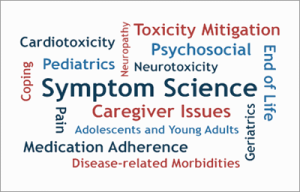
The Supportive Care and Symptom Management program supports studies on the prevention or treatment of acute and chronic symptoms and morbidities related to cancer and its treatment. This includes the impact on the quality of life of patients and their informal caregivers. The program also supports studies of patients and their caregivers at the end of life.
On This Page
- All Heading 2s will automatically be pulled in to this list.
- Do not edit the content on this template.
About Supportive Care and Symptom Management
The program supports research in three areas: prevention or treatment of acute or chronic symptoms and morbidities related to cancer, its treatment and caregiving (symptom management research); effects on quality of life from cancer, its treatment and caregiving (quality of life research); and end-of-life psychosocial issues, caregiving and treatment strategies (end-of-life research).
Through the NCI Community Oncology Research Program (NCORP), clinical trials are underway to evaluate therapies to prevent or ameliorate a broad range of symptoms and/or toxicities associated with cancer its treatment and caregiving. Other studies funded separately are investigating a range of treatment effects on health-related quality of life and a variety of influences on the end-of-life cancer experience.
Topic Areas include: Anorexia, Cachexia, Cardiotoxicity, Caregiver Issues, Cognitive Dysfunction, Distress/Anxiety/Depression, End of Life, Fatigue, Geriatrics, Hot Flashes, Lymphedema, Medication Adherence, Mucositis, Multiple Symptoms, Musculoskeletal Symptoms, Nausea, Neuropathy, Nutrition, Oral Complications, Other Supportive Care Issues, Pain, Palliative Care, Pediatrics/Adolescents/Young Adult, Physical Functioning, Quality of Life, Skin Toxicities, Sleep Disorders, and Urinary Complications.
Selected Topics
- HEAL Initiative
- Patient Resources on Side Effects of Cancer Treatment
- Patient Resources on Coping with Cancer
Resources
-
 Building Bridges in Cancer Symptom Science Webinar Series
This series is aimed at bringing together interdisciplinary researchers in cancer symptom science to share their expertise and further discussions in the field.
-
 DCP Early Career Scientist Spotlight Research Seminar Series
This seminar series highlights nominated early career scientists who are advancing research within the areas supported by DCP.
Funding Opportunities
No matching Funding Opportunities were found.
Grantee Details
Clinical Trials
| Title | Intervention | Sponsor | Status |
|---|---|---|---|
| Treating Breast Cancer Patients Undergoing Trastuzumab Treatment With Carvedilol to Reduce Incidence of Heart Failure | Carvedilol | Mayo Clinic | Active, not recruiting |
| Use of a Pre-Surgical Toolkit in Improving Surgical Care and Outcomes in Older Participants With Cancer | Best Practice, Informational Intervention, Informational Intervention with Coaching, Questionnaire Administration | Alliance for Clinical Trials in Oncology | Active, not recruiting |
| Methylphenidate and Exercise in Reducing Cancer-Related Fatigue in Patients With Prostate Cancer | Exercise Intervention, Methylphenidate, Placebo, Quality-of-Life Assessment, Questionnaire Administration, Stretching | M.D. Anderson Cancer Center | Active, not recruiting |
| Increasing Patients' Engagement in Breast Cancer Surgery Decision-Making | Usual Care, Web-based decision aid | Alliance for Clinical Trials in Oncology | Active, not recruiting |
| Nutrition Therapy in Improving Immune System in Patients With Bladder Cancer That Can Be Removed by Surgery | Laboratory Biomarker Analysis, Nutritional Intervention, Placebo Administration, Quality-of-Life Assessment, Questionnaire Administration | SWOG Cancer Research Network | Active, not recruiting |
| Haloperidol and Lorazepam in Controlling Symptoms of Persistent Agitated Delirium in Patients With Advanced Cancer Undergoing Palliative Care | Haloperidol, Lorazepam, Placebo, Quality-of-Life Assessment, Questionnaire Administration | M.D. Anderson Cancer Center | Active, not recruiting |
| Manual Therapy in Treating Fibrosis-Related Late Effect Dysphagia in Head and Neck Cancer Survivors | Manual Therapy | M.D. Anderson Cancer Center | Active, not recruiting |
| Financial Burden Assessment in Patients With Stage I-III Colon or Rectal Cancer Undergoing Treatment | Quality-of-Life Assessment, Questionnaire Administration | ECOG-ACRIN Cancer Research Group | Active, not recruiting |
| S1501 Dual Observational and Randomized Cohort Study of Patients With Metastatic HER-2+ Breast Cancer at Risk of Cardiac Toxicity | Carvedilol, Laboratory Biomarker Analysis, Patient Observation | SWOG Cancer Research Network | Recruiting |
| Dexamethasone in Controlling Dyspnea in Patients With Cancer | Dexamethasone, Questionnaire Administration, Placebo | M.D. Anderson Cancer Center | Active, not recruiting |
News and Events
Cancer Pain Research Addressing Multiple Causes, Multiple Managements
Date Posted: March 19, 2024
The Role of Neoantigen-Specific T-Cells in Cancer Interception and Immune Monitoring of Lynch Syndrome
Date Posted: February 22, 2024
Harnessing the Potential for Immune Interception in Pancreatic Cancer High-Risk Cohort
Date Posted: February 12, 2024
Lessons Learned, Opportunities, and Challenges – A Personal Perspective
Date Posted: February 6, 2024
Tuning the organ-selectivity of mRNA expression through dendrimer-based lipid nanoparticles
Date Posted: January 29, 2024