
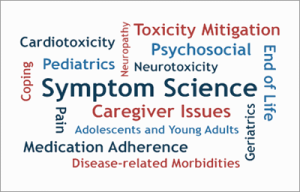
The Supportive Care and Symptom Management program supports studies on the prevention or treatment of acute and chronic symptoms and morbidities related to cancer and its treatment. This includes the impact on the quality of life of patients and their informal caregivers. The program also supports studies of patients and their caregivers at the end of life.
On This Page
- All Heading 2s will automatically be pulled in to this list.
- Do not edit the content on this template.
About Supportive Care and Symptom Management
The program supports research in three areas: prevention or treatment of acute or chronic symptoms and morbidities related to cancer, its treatment and caregiving (symptom management research); effects on quality of life from cancer, its treatment and caregiving (quality of life research); and end-of-life psychosocial issues, caregiving and treatment strategies (end-of-life research).
Through the NCI Community Oncology Research Program (NCORP), clinical trials are underway to evaluate therapies to prevent or ameliorate a broad range of symptoms and/or toxicities associated with cancer its treatment and caregiving. Other studies funded separately are investigating a range of treatment effects on health-related quality of life and a variety of influences on the end-of-life cancer experience.
Topic Areas include: Anorexia, Cachexia, Cardiotoxicity, Caregiver Issues, Cognitive Dysfunction, Distress/Anxiety/Depression, End of Life, Fatigue, Geriatrics, Hot Flashes, Lymphedema, Medication Adherence, Mucositis, Multiple Symptoms, Musculoskeletal Symptoms, Nausea, Neuropathy, Nutrition, Oral Complications, Other Supportive Care Issues, Pain, Palliative Care, Pediatrics/Adolescents/Young Adult, Physical Functioning, Quality of Life, Skin Toxicities, Sleep Disorders, and Urinary Complications.
Selected Topics
- HEAL Initiative
- Patient Resources on Side Effects of Cancer Treatment
- Patient Resources on Coping with Cancer
Resources
-
 Building Bridges in Cancer Symptom Science Webinar Series
This series is aimed at bringing together interdisciplinary researchers in cancer symptom science to share their expertise and further discussions in the field.
-
 DCP Early Career Scientist Spotlight Research Seminar Series
This seminar series highlights nominated early career scientists who are advancing research within the areas supported by DCP.
Funding Opportunities
No matching Funding Opportunities were found.
Clinical Trials
| Title | Intervention | Sponsor | Status |
|---|---|---|---|
| A Pilot Unrestricted Payment Program for Early-stage Cancer Patients: the PAYMENT Trial | Electronic Health Record Review, Interview, Support, Survey Administration | Fred Hutchinson Cancer Center | Not yet recruiting |
| Lanreotide Versus Placebo Before Surgery to Prevent a Surgical Complication Called a Pancreatic Fistula | Biospecimen Collection, Distal Pancreatectomy, Lanreotide, Questionnaire Administration, Saline | SWOG Cancer Research Network | Recruiting |
| Communication About Sexual Health in Gynecologic Cancer | Sexual Health Resources, Starting the Conversation | Fox Chase Cancer Center | Recruiting |
| Mosaic Trial for Stem Cell Transplant Recipients | Enhanced Usual Care (Control) Website, Intervention website | Northwestern University | Recruiting |
| The MIND-BC Study: MIND Diet for Breast Cancer Cognition | MIND Diet, Usual Diet | H. Lee Moffitt Cancer Center and Research Institute | Recruiting |
| Xylitol Dental Wipes for the Reduction of Bloodstream Infection Risk in Children With Acute Myeloid Leukemia | Best Practice, Biospecimen Collection, Cytarabine, Electronic Health Record Review, Placebo Administration, Xylitol-containing Oral Wipe | Children's Oncology Group | Not yet recruiting |
| Distance-Based Exercise to Preserve Function and Prevent Disability | Accelerometry, Aerobic Exercise Intervention, Dumbbell Exercise Intervention, Electronic Health Record Review, Exercise intervention, Interview, Questionnaire Administration, Telemedicine | Alliance for Clinical Trials in Oncology | Not yet recruiting |
| Surgical Thromboprophylaxis Practices in Oncology Patients Within the NCORP Network, STOP-VTE Study | Non-Interventional Study | Wake Forest University Health Sciences | Recruiting |
| Understanding Needs of Older Patients Prior to Starting Cancer Treatment | Assessment, Educational Intervention, Electronic Health Record Review, Internet-Based Intervention, Interview, Survey Administration | Wake Forest University Health Sciences | Enrolling by invitation |
News and Events
Important Symptom Management Findings Presented at 2023 ASCO Meeting
Date Posted: June 13, 2023
Research Highlights: Investigating Associations of Obesity with Colorectal and GI Cancers
Date Posted: June 5, 2023
Caregiver and Clinician Conversations about Increasing the Physical Activity of Pediatric Cancer Patients
Date Posted: September 29, 2022
Researchers Seek to Care for the Whole Patient
Date Posted: August 10, 2022