An official website of the United States government

Supportive Care and Symptom Management

The Supportive Care and Symptom Management program supports studies on the prevention or treatment of acute and chronic symptoms and morbidities related to cancer and its treatment. This includes the impact on the quality of life of patients and their informal caregivers. The program also supports studies of patients and their caregivers at the end of life.

On This Page

  • All Heading 2s will automatically be pulled in to this list.
  • Do not edit the content on this template.

About Supportive Care and Symptom Management

The program supports research in three areas: prevention or treatment of acute or chronic symptoms and morbidities related to cancer, its treatment and caregiving (symptom management research); effects on quality of life from cancer, its treatment and caregiving (quality of life research); and end-of-life psychosocial issues, caregiving and treatment strategies (end-of-life research).

Through the NCI Community Oncology Research Program (NCORP), clinical trials are underway to evaluate therapies to prevent or ameliorate a broad range of symptoms and/or toxicities associated with cancer its treatment and caregiving. Other studies funded separately are investigating a range of treatment effects on health-related quality of life and a variety of influences on the end-of-life cancer experience. 

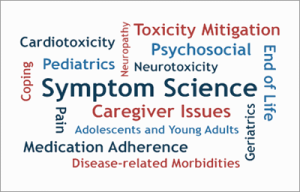
Topic Areas include: Anorexia, Cachexia, Cardiotoxicity, Caregiver Issues, Cognitive Dysfunction, Distress/Anxiety/Depression, End of Life, Fatigue, Geriatrics, Hot Flashes, Lymphedema, Medication Adherence, Mucositis, Multiple Symptoms, Musculoskeletal Symptoms, Nausea, Neuropathy, Nutrition, Oral Complications, Other Supportive Care Issues, Pain, Palliative Care, Pediatrics/Adolescents/Young Adult, Physical Functioning, Quality of Life, Skin Toxicities, Sleep Disorders, and Urinary Complications.

Selected Topics

Funding Opportunities

No matching Funding Opportunities were found.

View All Funding Opportunities

Grantee Details

PI Name Sort descending PI Organization Title Grant Number Program Official
Goel, Ajay

Beckman Research Institute/City Of Hope
United States

Exosomal biomarkers for the early detection of hepatocellular carcinoma 5R01CA271443-03 Matthew Young, Ph.D.
Goel, Ajay

Beckman Research Institute/City Of Hope
United States

Exosome-based microRNA biomarkers for Non-invasive and Early Detection of Pancreatic Cancer 3U01CA214254-08S2 Matthew Young, Ph.D.
Goel, Ajay

Beckman Research Institute/City Of Hope
United States

5mC and 5hmC DNA alterations as sensitive and specific biomarkers for the non-invasive early detection of pancreatic ductal adenocarcinoma 1U01CA296639-01A1 Claire Zhu, Ph.D.
Goggins, Michael G.

Johns Hopkins University
United States

Using markers to improve pancreatic cancer screening and surveillance: a multi-center study 5U01CA210170-09 Matthew Young, Ph.D.
Goncalves, Marcus Dasilva

New York University School Of Medicine
United States

Molecular Mechanisms of Fructose-induced Colorectal Cancer Cell Survival 5R01CA258697-05 Amit Kumar, Ph.D.
Gonzalez, Brian D

H. Lee Moffitt Cancer Ctr & Res Inst
United States

Impact of Targeted Therapy on Cancer-Related Cognitive Impairment 5R01CA287666-02 Brandy Heckman-Stoddard, Ph.D., M.P.H.
Gonzalez, Brian D

H. Lee Moffitt Cancer Ctr & Res Inst
United States

Impact of Targeted Therapy on Cancer-Related Cognitive Impairment 5R01CA287666-02 Brandy Heckman-Stoddard, Ph.D., M.P.H.
Goode, Diana J

University Of New England
United States

Novel expression of MHC class II on DRG neurons and its role in promoting antinociceptive CD4+ T cells in females during chemotherapy-induced peripheral neuropathy 5R01CA267554-04 Rachel Altshuler, Ph.D.
Goode, Diana J

University Of New England
United States

Novel expression of MHC class II on DRG neurons and its role in promoting antinociceptive CD4+ T cells in females during chemotherapy-induced peripheral neuropathy 5R01CA267554-04 Rachel Altshuler, Ph.D.
Grady, William Mallory

Fred Hutchinson Cancer Center
United States

Understanding adenoma progression: Interplay among tissue microenvironment, clonal architecture, and gut microbiome 3U54CA274374-04S2 Christos Patriotis, Ph.D., M.Sc.
Grady, William Mallory

Fred Hutchinson Cancer Center
United States

Biomarkers for optimizing risk prediction and early detection of cancers of the colon and esophagus 5U2CCA271902-04 Matthew Young, Ph.D.
Greene, Nicholas Perry

University Of Arkansas At Fayetteville
United States

DEVELOPMENT OF TARGETED APPROACHES IN PREVENTION OF CANCER-CACHEXIA 5R01AR075794-05 Brandy Heckman-Stoddard, Ph.D., M.P.H.
Greene, Nicholas Perry

University Of Arkansas At Fayetteville
United States

DEVELOPMENT OF TARGETED APPROACHES IN PREVENTION OF CANCER-CACHEXIA 5R01AR075794-05 Brandy Heckman-Stoddard, Ph.D., M.P.H.
Grimm, Lars J

Duke University
United States

Dynamic imaging and tissue biomarker models to delineate indolent from aggressive breast calcifications 4R01CA271237-04 Guillermo Marquez, Ph.D.
Grogan, Eric L

Vanderbilt University Medical Center
United States

Clinical Utility of Biomarkers Driven Management of Indeterminate Pulmonary Nodules 5R01CA252964-05 Claire Zhu, Ph.D.

Clinical Trials

Status

No matching Clinical Trials were found.

View All Clinical Trials